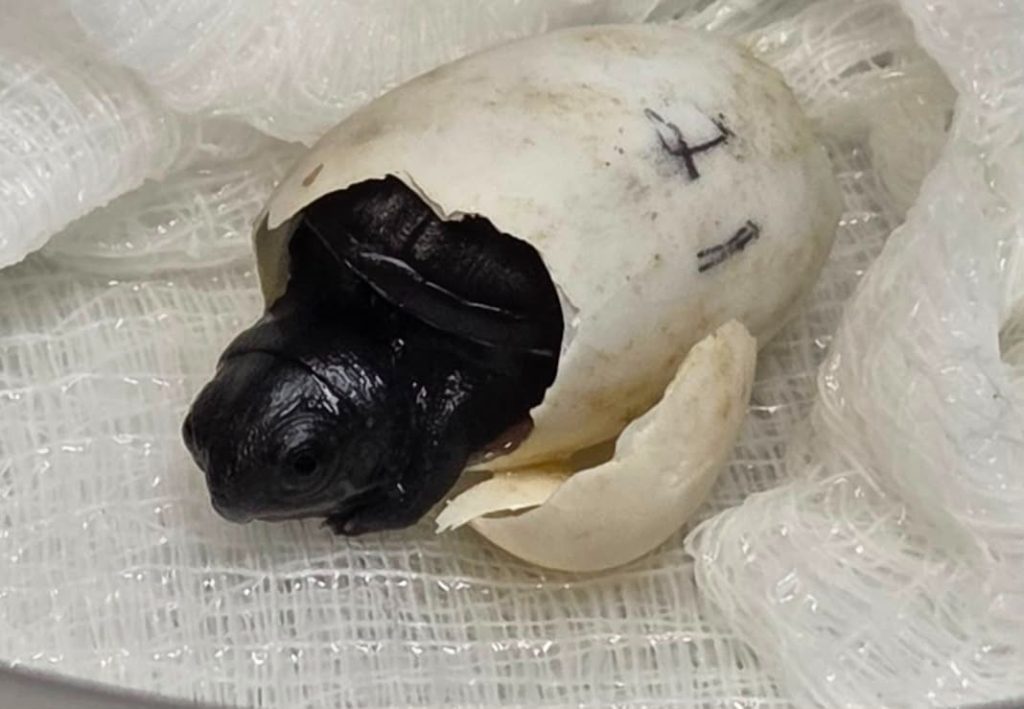
The Guadalajara Zoo has consolidated what conservation experts are already classifying as one of the most important herpetological successes in recent years. The Jalisco-based sanctuary confirmed the birth of three new hatchlings of the Vallarta mud turtle (Kinosternon vogti), the most threatened freshwater turtle species on the planet.
This second consecutive milestone is no minor feat. Following the historic birth of a single hatchling last year, the team of specialists subtly modified laboratory variables—adjusting humidity, temperature, and diapause periods (the pause in embryo development). The result of fine-tuning the scientific protocol was a resounding success: the birth rate tripled.
With fewer than 300 individuals left in the wild due to urban pressure on the canals of Puerto Vallarta, this breakthrough by Mexican science becomes the primary barrier preventing the species from going extinct.
Data on the New Hatchlings
The three new specimens broke through their shells recently and are in optimal health, registering dimensions that barely compete with the size of a small coin:
| Specimen | Date of Birth | Dimensions | Official Weight |
| Second Hatchling | April 4, 2026 | 2.2 x 1.8 cm | 2.1 grams |
| Third Hatchling | April 17, 2026 | 1.9 x 1.6 cm | 2.0 grams |
| Fourth Hatchling | June 8, 2026 | 2.2 x 1.7 cm | 3.0 grams |
To celebrate their Mexican roots and heritage, the zoo’s technical team named the tiny turtles Coapinol and Tami (alluding to local bodies of water in the coastal region) and Vallarta, in honor of the municipality where this micro-endemic species was originally discovered in 2018. The success of the Jalisco laboratory proves that, with rigor and perseverance, science can still rewrite the destiny of critically endangered fauna.
About the Author